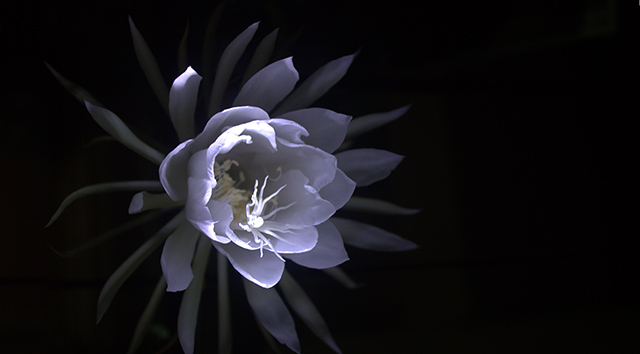
Queen of the NightQueen of the Night blooms at night. By next day morning, the flower would have withered. Furthermore, the flowers bloom only once a year. The short life means that the flowers cannot be photographed if one is not ready at the right time.
When a Queen of the Night started to open in my garden, I kept a watch. At around 10 at night, the petals had opened up. But the light was low and I could hardly make out the flower in the darkness.
A flash did not produce the desired result. I then used an LED light. It was directed upwards at the flower. Exposure was f/4.5 at 1/50 sec. ISO rating was 400. Subject distance was 380 mm. I made several shots and then photomerged them together in Photoshop.
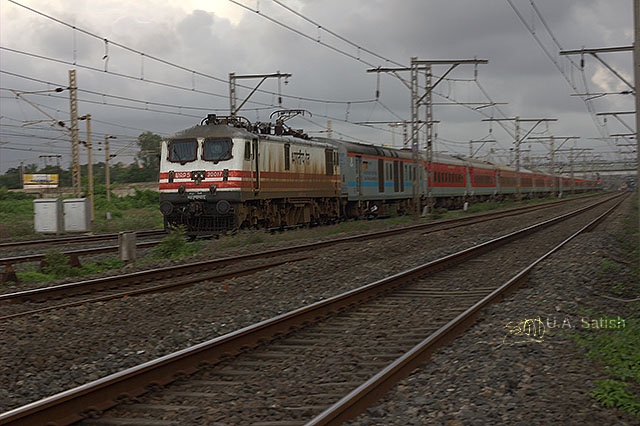
Electric Locomotive Ghaziabad WAP-5 #30017 Hauling August Kranti Rajadhani ExpressIndian Railways uses a class of electric locomotives called WAP-5. The WAP-5 series of locomotives haul the premium trains on Indian Railways like the Mumbai Rajdhani Express, Bhopal Shatabdi Express, Lucknow Shatabdi Express, Thiruvananthapuram Rajdhani, Prayagraj Express, etc. The Bhopal Shatabdi hauled by a WAP-5 travels at 150 km/h (93 mph) in the New Delhi – Agra Cantt section.
The first 10 locomotives were imported from ABB in Switzerland in 1995. They are supposed to be a variant of the Swiss Lok 2000 (Design Concept) and German DB Class 120 (Mechanical Chasis). Chittaranjan Locomotive Works (CLW) started production in 2000. It was designed to haul 18 coach passenger trains at 162 km/h (101 mph). It is the first 3-phase locomotive in India.
Other key features of the locomotive are the provision of taps from the main transformers for Head end power (HEP or Hotel Load), pantry loads, flexible gear coupling, wheel-mounted disc brakes, and a potential for speed enhancement to 225 km/h (140 mph). Braking systems include regenerative braking (160 kN), loco disc brakes, automatic train air brakes, and a charged spring parking brake. MU operation possible with a maximum of two locos. At trials, a WAP-5 has been tested up to 185 km/h (115 mph).
Around 60 of these locomotives have been put to service as of January 2013.
@ Wikipedia
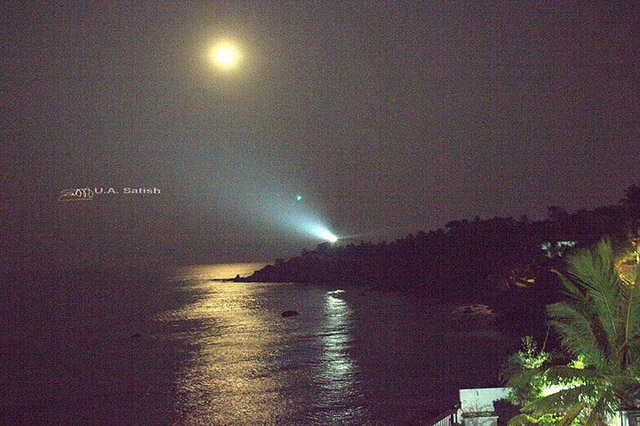
Moonlit Light HouseKannur Light House in Kerala is near Payyambalam Beach, a few kilometers from Kannur town. It is adjacent to Government Guest House. The light house is still active and overlooks the Arabian Sea.
Cannanore is the old English name for Kannur town. The light house at Kannur is still often referred to as the Cannanore Light House.
I had to wait patiently till almost midnight for the moon to come up close to the light house. I used a one second exposure at f/4.0. ISO setting was at 800 and focal length was 21 mm.
I was not carrying a tripod, so I had to prop up my Canon EOS 550D camera against a window sill. The sky was cloudless with no haze or mist. So I was able to get a clear shot.
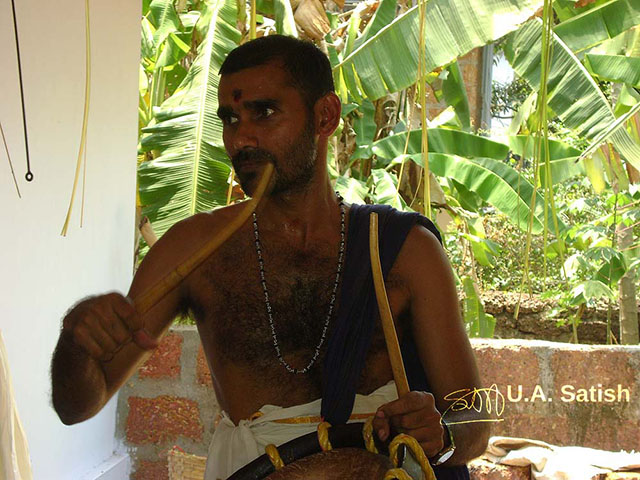
ChendakkaranA temple in Thalassery, Kerala is Ambalavattam Temple. It is owned by Ambalavattam family and is managed by a charitable trust.
I shot this image at the temple during a festival. The Chenda is mainly played in Hindu temple festivals and as an accompaniment in the religious art forms of Kerala. The Chenda is a cylindrical percussion instrument used widely in Kerala.
Panchari melam, comprising of instruments like chenda, ilathalam, kombu and kuzhal, is performed during virtually every temple festival in central Kerala. Another chenda melam which comes close to Panchari in popularity is Pandi Melam. Other chenda melams include chempata, adanta, anchatanta, chempha, dhruvam, navam, kalpam and ekadasam.
Click on the link to see an interesting image from Flickr by Ranjith Shenoy R: Rhythm of Kerala
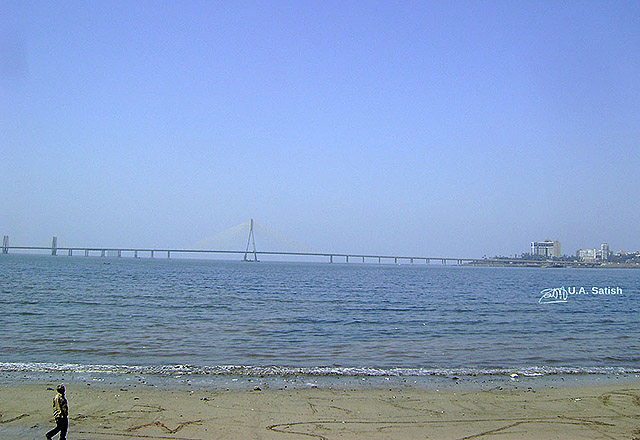
Bandra Sea Link is a unique cable stay bridge in the waters of Arabian Sea. It connects Bandra Reclamation with Worli in South Mumbai. It runs for 5.6 km over the Arabian Sea. Travel time is 20-30 min. Motorcycles and pedestrians are not allowed on the sealink.
First four lanes were opened to traffic in June 2009. All eight lanes were opened on 24 March 2010. It took ten years to complete and is considered an engineering marvel. It cost USD 280 million to build. Daily traffic count on the bridge is 40,000 vehicles.
This shot was taken from Shivaji Park area. Bandra end of the sealink is seen to the right.